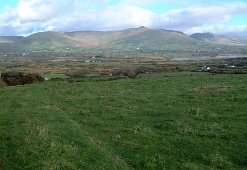
Pure ugliness is another form of environmental blight. Ireland has the most beautiful landscape and yet nobody seems to care that it is blemished with more and more fengshui-opposed telephone poles. Those poles should be removed as they have been in most European towns and villages. Yet, driving back to Dingle from Tralee, along the stretch that is being repaved there are even more poles waiting to be set up, instead of using the opportunity to bury the wires while repaving the road. Electricity belongs underground; we are surely not healthier for being under its crisses and crosses. And our unseeing eyes, tho' used to the spectacle and so shutting it out, still suffer from the sight. A great Native American once foresaw the future which he described as people wandering about under endless spider webs. Fie on the planning!
Thursday, June 14, 2007
Pure ugliness is another form of environmental blight. Ireland has the most beautiful landscape and yet nobody seems to care that it is blemished with more and more fengshui-opposed telephone poles. Those poles should be removed as they have been in most European towns and villages. Yet, driving back to Dingle from Tralee, along the stretch that is being repaved there are even more poles waiting to be set up, instead of using the opportunity to bury the wires while repaving the road. Electricity belongs underground; we are surely not healthier for being under its crisses and crosses. And our unseeing eyes, tho' used to the spectacle and so shutting it out, still suffer from the sight. A great Native American once foresaw the future which he described as people wandering about under endless spider webs. Fie on the planning!

Wednesday, June 13, 2007
They buried Tara underneath the grass
And herded bullocks o'er the graves of Kings
And cursed us for the memory that clings
To our dead lions, not their living ass.
They joyed to see the Celtic culture pass
And all its glories, song and art, take wings
And now the dogs they do pretend it stings,
Souls hidden in impenetrable brass,
Because some passing alien steals the name
Not they but we held sacred...hush you dogs--
Sorrows divine can touch you not, you may
Never be champions of our island's fame
Who changed its harp notes for the grunts of hogs
Your Tara is...
Tara-de-boom-de-ray
This poem was written by Geoge Russell (AE) the almost forgotten hero of the Irish Renaissance. One would do well to look into his works.
Sunday, May 27, 2007
 A spiritual perspective on climate change
Tomás Bonek
an abbreviated translation, reprinted from Das Goetheanum Nr.5.07
for the complete article see the summer issue of LILIPOH
In primeval times the people regarded climate change as a result of their own actions, as we do today. In many cultures this was portrayed in legends of the flood. The immense water disaster described in Genesis was not only destructive—Noah became the founder of a new culture. From destruction and chaos a new world and a new humanity were born. The end of the ice age which is identified with the flood brought fundamental climate change, which allowed the development of modern mankind in the different cultural epochs. We are also in a time of global climate change. Much that was learned about weather during the past centuries seems not quite to apply anymore. The sun was never as active during the past 12,000 years as it has been since the 30s of the 20th Century. It is a sign of the times that even experts find it hard to predict the next developments. As against this we are obviously embedded in a larger cosmic order. Maria Thun, interestingly, can predict the main climate trends in any given year by her study of the planets and constellations (see her Bd Sowing & Planting Calendar 2007). This past winter for example she predicted that there would not be any real winter weather in Central Europe until the middle of January, and she was correct. Can we consider that climate change may be influenced by us but that its movements are also part of a cosmic evolution? If so, we can say: 'humanity influences climate ' and likewise: 'climate influences humanity. ' Although it may have been understood very differently in ancient times this still seems to be a relevant maxim. Indeed, while the question of how to arrest these changes is justified, it appears that the larger natural system is no longer stable—and therefore not in our complete control. So the question ought rather to be: 'how do we learn to live in and with the changed situation?
In primeval times the people regarded climate change as a result of their own actions, as we do today. In many cultures this was portrayed in legends of the flood. The immense water disaster described in Genesis was not only destructive—Noah became the founder of a new culture. From destruction and chaos a new world and a new humanity were born. The end of the ice age which is identified with the flood brought fundamental climate change, which allowed the development of modern mankind in the different cultural epochs. We are also in a time of global climate change. Much that was learned about weather during the past centuries seems not quite to apply anymore. The sun was never as active during the past 12,000 years as it has been since the 30s of the 20th Century. It is a sign of the times that even experts find it hard to predict the next developments. As against this we are obviously embedded in a larger cosmic order. Maria Thun, interestingly, can predict the main climate trends in any given year by her study of the planets and constellations (see her Bd Sowing & Planting Calendar 2007). This past winter for example she predicted that there would not be any real winter weather in Central Europe until the middle of January, and she was correct. Can we consider that climate change may be influenced by us but that its movements are also part of a cosmic evolution? If so, we can say: 'humanity influences climate ' and likewise: 'climate influences humanity. ' Although it may have been understood very differently in ancient times this still seems to be a relevant maxim. Indeed, while the question of how to arrest these changes is justified, it appears that the larger natural system is no longer stable—and therefore not in our complete control. So the question ought rather to be: 'how do we learn to live in and with the changed situation?
A fascinating aspect of our times is that there is fundamental change in three areas at once. So-called globalization is an immense 'climate change'. Subjectively the earth has never been as ‘small’ as it is now. Never before have so many people felt homeless--inwardly and outwardly--and yet so connected with one another. Never have time-honoured traditions come under such scrutiny before and never was there such worldwide insecurity regarding the future.
All three changes—in the heavens, the elements, and among people—are described in the Gospel: ' And there shall be signs in the sun, and in the moon, and in the stars; and upon the earth distress of nations, with perplexity, the sea and the waves roaring [...] for the powers of heaven shall be shaken.' However, an important motif is added: ' And then shall they see the Son of man coming in a cloud with power and great glory. (Luke: 21) When the solid earth starts to disappear under one's feet and everything comes into a state of flux, people are especially open to the spirit. Then it is time to consider the message behind the phenomena. If the world is unstable tomorrow the question will no longer be how and why it is happening, rather how we will react to it. Everyone clinging to the experiences of the past will be helpless. For the future, a living understanding of the present will be crucial. Those learning to love their destiny in the midst of all change, and who can look inward with a newly awakend conscience and outward with compassion will prevail. Only then can we hope that chaos will not end in catastrophe, and that we will be raised to a heightened/etheric rather than a destructive/merely biological, condition of life.
Tomás Bonek is a priest of the Christian Community in the Czech Republic
All three changes—in the heavens, the elements, and among people—are described in the Gospel: ' And there shall be signs in the sun, and in the moon, and in the stars; and upon the earth distress of nations, with perplexity, the sea and the waves roaring [...] for the powers of heaven shall be shaken.' However, an important motif is added: ' And then shall they see the Son of man coming in a cloud with power and great glory. (Luke: 21) When the solid earth starts to disappear under one's feet and everything comes into a state of flux, people are especially open to the spirit. Then it is time to consider the message behind the phenomena. If the world is unstable tomorrow the question will no longer be how and why it is happening, rather how we will react to it. Everyone clinging to the experiences of the past will be helpless. For the future, a living understanding of the present will be crucial. Those learning to love their destiny in the midst of all change, and who can look inward with a newly awakend conscience and outward with compassion will prevail. Only then can we hope that chaos will not end in catastrophe, and that we will be raised to a heightened/etheric rather than a destructive/merely biological, condition of life.
Tomás Bonek is a priest of the Christian Community in the Czech Republic
Sources: Earthly and Cosmic Man, R.Steiner
Thursday, April 12, 2007
BEES  DISAPPEARED WITHOUT A TRACE
As reported in US media, thousands of beekeepers have found their hives empty following the winter season. There is no clue as to the whereabouts of the bees. It is believed that the bee population has been reduced by 60-70% The cost of crop failure due to lack of pollination is calculated in the billions of dollars. To a lesser degree bees have been dying in Europe but nothing to the extent of the United States. Walter Haefeker of the Council of German Beekeepers (Deutschen Imkerbundes) suspects a connection with the extensive genetically altered maize production (comprising roughly 40% of all plantings). Two years ago researchers in the University Jena (Germany) found links between genetically modified corn and immune weakened bees, but the resources to continue their studies were not made available. Source: www.info3.de Nr 4 April 2007 photo courtesy wikipedia
 DISAPPEARED WITHOUT A TRACE
As reported in US media, thousands of beekeepers have found their hives empty following the winter season. There is no clue as to the whereabouts of the bees. It is believed that the bee population has been reduced by 60-70% The cost of crop failure due to lack of pollination is calculated in the billions of dollars. To a lesser degree bees have been dying in Europe but nothing to the extent of the United States. Walter Haefeker of the Council of German Beekeepers (Deutschen Imkerbundes) suspects a connection with the extensive genetically altered maize production (comprising roughly 40% of all plantings). Two years ago researchers in the University Jena (Germany) found links between genetically modified corn and immune weakened bees, but the resources to continue their studies were not made available. Source: www.info3.de Nr 4 April 2007 photo courtesy wikipedia
Saturday, March 10, 2007
Believe It or Not
 On 25/02/07 David Fairclough wrote:
In the last few weeks, two new stars have appeared in the constellation of Scorpius. The first named Nova Scorpii 2007 was discovered on 6 February while it was only visible by telescope, then brightened until 13 February when it became visible to the naked eye. The star brightened further, but has since faded slightly although it is still (just) visible in the pre dawn skies in the southeast, just south of Jupiter.
The second star "appeared" on 21 February, a mere 3 degrees from the first. It is not as bright as the first "nova", but it is visible with binoculars.
The following text is from R. Steiner's The Festivals and their Meaning, No.3, Ascension and Pentecost). It is significant in that it shows the universe to be ensouled ('astral'), alive ('etheric'), and in close interaction with us, as was well known in earlier stages of humanity but is often regarded as unscientific or worse today.
"Every star that we see in the heavens is in reality a gate of entry for the astral. Wherever the stars glitter in towards us, there glitters and shines the astral. Look at the starry heavens in their manifold variety; in one part the stars are gathered in clusters; in another they are scattered far apart. In all this wonderful configuration of radiant light, the invisible and super-sensible astral body of the cosmos makes itself visible to us.
For this reason we should not consider the world of stars unspiritually. To speak of worlds of burning gases is just as though—forgive the apparent absurdity of the comparison, but it is precisely true—someone who loves you were gently stroking you, holding their fingers slightly apart, and you were to say that it felt like so many ribbons drawn across your cheek. It is no more untrue that ribbons are laid across your cheek when someone strokes you, than that there exist up there in the heavens those material entities of which modern physics tells. It is the astral body of the universe which is perpetually wielding its influences on the etheric organism of the Cosmos. The etheric Cosmos is organised for very long duration; it is for this reason that a star has its quality of fixity, representing a perpetual influence on the cosmic ether by the astral universe. It lasts far longer than the stroking of your cheek. But in the Cosmos things do last longer, for there we are dealing with gigantic measures. Thus in the starry heavens that we actually behold an expression of the soul-life of the cosmic astral world. An immense, unfathomable life, yet, at the same time, a soul-life, a real and actual life of the soul, is brought into the Cosmos. Think how dead the Cosmos appears to us when we look into the far spaces and see nothing but burning gaseous bodies. Think how living it all becomes when we know that the stars are an expression of the love with which the astral Cosmos works upon the etheric Cosmos—for this is to express it with perfect truth. Think then of those mysterious processes when certain stars suddenly light up at certain times—processes which have only been explained to us by means of physical hypotheses that do not lead to any real understanding. Stars that were not there before, light up for a time, and disappear again. For it is true indeed that in epochs when divine Beings desire to work in a special way from the astral world into the etheric, we behold new stars light up and fade away again. Illustration: V van Gogh, Night Sky
Wednesday, January 24, 2007

In order to penetrate ever further into their subjects, the host of specialists narrow their field and dig down deeper and deeper till they can't see each other from hole to hole. But the treasures their toil brings to light they place on the ground above. A different kind of specialist should be sitting there, the only one still missing. He would not go down any hole, but would stay on top and piece all the different facts together. -- Thor Heyerdahl, Aku-Aku
Saturday, December 16, 2006
 Fluoride...it doesn't go away
Look at this fluoride crystal, beautiful and yet disturbing. Seen one way it reminds of a hardened old man, pointing; frozen in a 'Lot's wife' gesture.
Every time an article appears anywhere discussing the problems connected with fluoride in our water supply you can be sure that a few weeks later there will be a counter article with 'scientific evidence' of its merits.
Such a recent article appeared in the Irish Examiner, Friday, 15 November, and it was an affront to intelligence. It was expected; a month or so before there had been an announcement that the percentage of fluoride in our water would be reduced.
The article was titled Fluoride in water reduces tooth decay. It cited a study commissioned by the government called North South Survey of Children's Oral Health in Ireland. However it omitted to mention which organization or company had been commissioned to do the study or what their interest might be. The article stated that children from 1984 to the present were compared, as though the addition of fluoride to water had been the only change in childrens' lives during that time. The article was also obscure in other ways, quoting the Irish Dental Association as questioning 'the department's credibility on dental issues.'
We need to know that there are only three countries left in the EU that continue to fluoridate their water supply, Ireland, the UK and Spain. Of these Ireland is the most heavily fluoridated. All other countries have found fluoridation to be ineffective at best and harmful at worst. We also need to know that recycling fluoride, a waste product of the chemical industry, is a lucrative business.
Switzerland has not had fluoridation with the exception of the city of Basel which ended its use in 2003 by overwhelming vote. To quote the GSK (Basel Health and Social Commission):
..serious doubts had arisen about the effectiveness of water fluoridation. Adding to these doubts were recent findings showing that tooth decay had risen in Basel's children since 1996, coupled with an absence of any evidence showing Basel to have a lower rate of tooth decay than other Swiss cities.
According to Board member Tobias Studer, 'the freedom of the individual to choose the appropriate prophylaxis method was also a major point in the debate.'
As noted in the GSK report, 'only a minimal part of so-called drinking water is used for drinking and cooking.' The GSK estimated that 'over 99% of the fluoride' added to water is never consumed by humans, leading in turn to 'an unnecessary load on the environment...Fluoride is a poison that loads our rivers.'
It was supposed that fluoridation of table salt has a much higher efficiency.
Moreover, when a medicinal product is added to the water supply there is an inability on the part of governments to control the dose each individual receives, due to the wide variation that exists not only in individual water consumption but also in exposures to fluoride from other sources. The inability to control the dose is particularly important considering:
* Exposure to fluoridated water doesn't just last a week or a month, but an entire lifetime.
* Individual susceptibilities to fluoride vary greatly (eg those with impaired kidney function or nutritional deficiencies are more vulnerable to fluoride's toxic effects).
*The margin of safety between the range of fluoride exposures typically found in fluoridated communities and the range of exposures associated with fluoride-related health problems (such as arthritis and bone fracture) are poorly defined and, if existent, remarkably narrow.
In the United States water fluoridation is touted by government authorites as being 'one of the top 10 public health achievements of the 20th century.' The Centers for Disease Control state that water fluoridation has been the key factor in the decline of cavities among US children during the past 50 years. Based on such statements from the US Government one could be forgiven for assuming that Western Europe has somehow suffered higher rates of tooth decay by not fluoridating its water.
However, according to extensive data compiled by the World Health Organization, unfluoridated countries in Western Europe including countries with little or no salt fluoridation have experienced, without exception, the same general decline in tooth decay over the past 30 to 50 years, as that experienced in the US...children today in unfluoridated countries such as Denmark, Germany, The Netherlands and Sweden have as low--or even lower--levels of tooth decay as US children.
The evidence from Europe, therefore, suggests that water fluoridation is an entirely replaceable and unnecessary means of reducing tooth decay--a fact consistent with the Basel Health and Social Commission's conclusions, but at profound odds with the massive promotion campaign by the US Government to fluoridate more water in the US.
The above information was reported by Michael Connett and can be accessed at http://fluoridealert.org/basel.htm
This brings us back to the beginning of this post and the wizened fellow in the photo. Fluoride is a powerful poison. It hardens, and not only teeth. Over time it will affect the hypermineralization of bone (NIA Workshop on Aging and Bone Quality, 1992, Bethesda Maryland) and who knows what hardening effect it has on the brain or other tissues. Such studies may perhaps exist, or they may not. In any case it is not responsible to inflict this poison on Ireland's water supply.
Sunday, November 19, 2006
 Contemplations on Politie
 The writer, poet and ‘myriad man’ George Russell (AE) wrote in 1912:
I fear that (even) without State socialism we may yet get worship of the State and belief in its powers, developed to such an extent that the community will place itself completely in the hands of the government to the utter destruction of self-reliance, initiative and independence of spirit. When a man becomes feeble-minded his friends place him in a home. When a people grow decadent and feeble-minded they place themselves in the hands of the State…
If an individual, ignoring the wise warning of the Gospels, condemns any one over much, what he condemns is meted out to him. If he says some one is very vain, vanity blooms all over him as he speaks, for the remark implies that the speaker believes he is stainless so far as this fault is concerned. If he says some one else is a most irritable person, he grows irritated himself, and so on through the whole range of emotions.
Any philosopher who studied Irish problems calmly, if such a thing were possible, and seeing the intense hatred of the Irish of any government they had to deal with, could have prophesied they were bringing upon themselves the fate of being the most governed people on the face of the earth. Already one in every forty persons in Ireland is in the employment of the State and the demand for more government departments is increasing with feverish intensity. Within only the last couple of years demands have been made for a department with a million a year to develop industries. Forestry eagerly claimed a department all to itself. Next the railways were to be bought by the State and departmentalized also. Another demand was for State banking, and the income of the already existing departments has never been sufficient to satisfy either the departments or the people. They always ought to be doubled. The State is rapidly becoming a kind of fetish in Ireland, a fetish which is kicked and prayed to alternately, the kicking testifying to as much belief as the prayers.
We complain quite justly that we are the most expensively governed people in Europe and we go on asking for more expensive government departments. If we got all the things we ask for those who asked for them would instantly count up the cost, add it to that of already existing departments to prove still more conclusively that the solar system could not possibly contain a more expensively governed race and this would be put forward as a new reason why still more departments should be founded to balance or redress the wrong. Any one who has the misfortune I have of being forced every week to read a great number of country papers will bear me out when I say that nothing is more common than the demand in every parish meeting, board of guardians, rural or urban council, for State aid or State subsidies in some form of other. It is the tragedy of the decline and fall of the human will in the people we are witnessing, a far worse tragedy than the emigration which is deplored so much. The will is growing powerless to act without partnership with its fetish or idol the State…
…The forms which a social order may take are many. The best is that which produces the finest type of human being, with the social or kindly instincts most strongly developed. The worst thing which can happen to a social community is to have no social order at all, where every man is for himself and the devil may take the hindmost. Generally in such a community he takes the front rank as well as the stragglers. The phrase ‘Every man for himself, is one of the maxims in the gospel according to Beelzebub. The devil’s game with men is to divide and conquer them. Isolate your man from obligations to social order and in most cases his soul drops into the pit like a rotten apple from the Tree of Life. Fine character in a race is evolved and not taught.
Friday, September 08, 2006
 Visitor
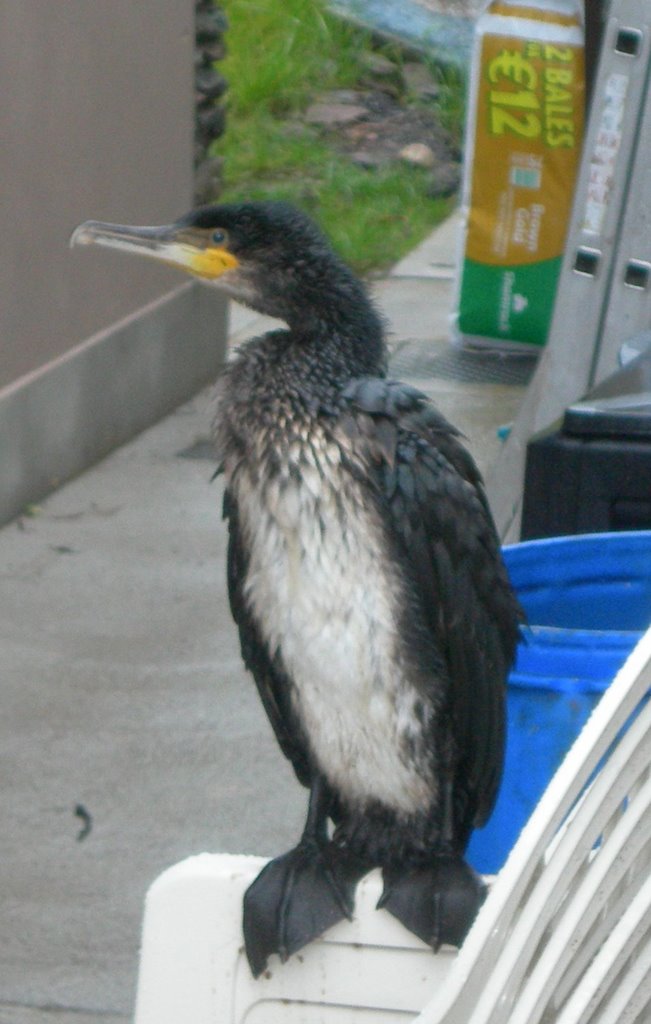
It suddenly appeared, feathers ruffled, tired, hobbling from wall to perch, unbalanced.
And yet with dignity and quiet.
It's head, held on the perch of its neck, swung slowly back and forth, then rested as if pondering, gathering itself inward. I brought it little shrimps in water, but they were declined and rather, by the next day, head was under wing.
It was not disturbed in its silent sleep, but I wondered, would the life ebb from the beautiful body? I quite expected this when I came down the following morning and was amazed to find the discrete thing gone without a trace. What a privilege it was, to meet this child of nature.
Friday, September 01, 2006

Three Basic Rules
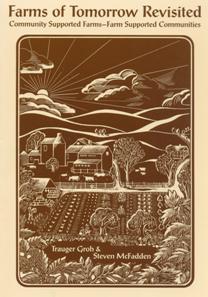
Trauger Groh, who was described earlier in this blog, visited several farms here in Dingle in June. He will be back soon to give some workshops. For now, here is a quote from his book Farms of Tomorrow Revisited:
The farms of tomorrow will not be just family farms. They will be so complex and diversified that they will require the cooperation of many different, unrelated, free people. Such farms will need the cooperation of several households as well as the open support of households whose members are not actively farming but who share the responsibility, the costs, and the produce with the active farmer.
Three basic rules were once given to Trauger Groh by Wilhelm Barkhoff, a lawyer who had a deep interest in and personal experience with these questions…In many years of farming Trauger has found them to be true and helpful.
The first rule, do not work too many hours. Farming is labour, craft and art. The art arises out of a deeper understanding of nature based on thorough ongoing observation, reflection, and meditation on all surrounding natural phenomena and processes. If the active farmer is working too long hours, he lacks the leisure for this. He loses his art, handing it over to extension services and agricultural schools. They themselves transform the art of farming, which is the true agriculture, into materialistic natural science and they transform the inherent, developed economics of the farm organism into a merely profit-oriented exploitive agronomy of plant and animal production. Finally the farmer is no longer, he is just applying their recipes. In the end he loses a lot of his craft depending less and less on farm skills and more and more on the supply of sophisticated machinery. He often becomes a badly paid, highly indebted labourer with hopefully high technical skills.
The second rule, buy for the farm as little as possible from the outside world. The less you purchase in the way of sophisticated tools, machinery and farm buildings the more you are financially independent and free to work with and out of nature. Use the help and skills of all friends who are related to the farm. The secret of successful Amish economic life lies in relying on human beings to work the farm and not buying too many things…
The third rule, take all the initiative for your actions on the farm out of the realm of the spirit, not out of the realm of money. What does this mean? The more we penetrate the spheres of nature, the more we become aware that what surrounds us in it is of overwhelming wisdom. What we call scientifically an ecosystem is penetrated by wisdom so that all parts serve the whole in the most economic way. In awe we stand before the higher ‘intellect’ of a bee-hive, or an ant colony. The cooperation of micro-organisms, earthworms, springtails, and others in the soil in breaking down plant material and in building humus is something deeply rational and wise which cannot be copied or synthesized by man . This we can describe as the spirit that is spread out in nature. This spirit organizes nature with the highest economy. The more we understand and follow this ‘wisdom’ in nature, this outspread ‘spirit’ the more rationally and therefore economically we can organize the farms of tomorrow. The profit motivation, applied to nature, has led to vast depletion of soil and dangerous exploitation of animals and plant material. If we follow the spirit in nature, we put into our service both the rationale and the economy of nature. This, ultimately, is the basis of the life of humanity.
Tuesday, July 04, 2006

Bird Flu
In 2000 and 2001, during spring and summer, we were inundated with warnings about ‘West Nile Virus’ affecting crows and other birds. The local news reported numbers of unnamed human deaths—sometimes 7, other times 5 or 3, somewhere in a vague part of Long Island or New York City. I couldn’t help but question these reports; not of course that birds might be dying, but the hysteria which culminated in part of our county being sprayed with an offensive chemical, by helicopter. We were assured that the spraying was harmless to humans, yet were warned to stay indoors. Later there were reports of people with adverse reactions to the spraying. Then all was quiet.
This past year the bird flu (H5N1) scare was pervasive in Europe and by all accounts continuing in the Far East. Free range chickens in the European Union were been banned indoors by order of law, and a vaccine, Tamiflu, speedily developed by a drug manufacturer. It was the I-don’t-know-what’s-going-on talk of the day. Now summer has come and the birds are here but, suddenly, again, all is quiet. Again, I have no doubt birds sicken and die. But why?
An article appeared in ‘Das Goetheanum’ Swiss weekly newsletter, 19. May, 2006, by Michael Kalisch. The title translates as: How Fare the Birds? Here is a condensed review:
We have read about sick and dying birds in epidemic numbers in Asia and that there was an outbreak of bird flu in Turkey. In the European Union the virus was found in some wild birds and predatory animals, and even in some pets but with little or no outbreak. However the risk of a pandemic is assumed because the bird flu virus might mutate into a highly pathogenic version and, because a flu epidemic is overdue.
Birds have been prone to bird flu for many years. Since1997 app 180 people worldwide have contracted it. About half of those died. According to the World Health Organization well over 100 000 people die of regular flu each year. Bird flu assumes very close contact with infected animals. But to date no-one has observed an infection caused by a wild bird, and so far no tourist has contracted bird flu in any of the affected countries.
Migratory birds and ‘dirty’ small farms have been blamed for the spread of bird flu. However the pathways of bird flu from East to West have been found to follow trade routes. The virus type is the same in China as in Turkey, the location of the only significant outbreak outside Asia.
The migration theory doesn’t hold up. Countries such as Australia, visited by wild birds from Asian countries, show no cases of bird flu. Nigeria had an outbreak, outside migrating season, in one isolated chicken factory. Suspicion was that the factory imported chicks illegally froman affected country. In China wild birds carrying the virus died near a lake surrounded by industrial poultry farms which suggests that the birds were infected with a highly pathogenic variant, by the chickens, through the discarded excretions.
In Asia the poultry industry is undergoing a revolution with gigantic industrial growth, distributing beyond their borders, for example into Turkey. As in the seed industry, the old, local poultry breeds (optimally suited to their environment, resistant, rich taste) have been lost. A few ‘industrial’ breeds are distributed world wide by four Asian mega-companies intent on expansion. Whoever wishes to raise chickens must now buy everything from one of these concerns; livestock, feed, composted manure. (Laos stands out as a contrast. In that country 90% of poultry sold is raised on traditional small farms. As of March 2006 there were 45 bird flu cases in Laos, 42 of them occurring in one of the few poultry factories).
Thus we find not only the route but the probable origin of this highly virulent version of the bird flu virus. Mass, or ‘battery’ production of fowl not only weakens their resistance but allows for a rapid selection of already adapted ‘successful’ virus variants. Hens subjected to forced growth suffer the most, living in artificial light and ventilation, with bone weakness, ulcers, deformations and breathing difficulties, and with a constant uptake of antibiotics.
Is the solution mass culling and free range hens locked in covered sheds, or a ban on keeping poultry altogether? Or should the EU develop guidelines taking into consideration what chickens require to keep themselves, and us, healthy?
Monday, June 12, 2006
Calendar of the Soul
(for Gabriela)
In 1912 Rudolf Steiner brought out a remarkable calendar which among other things provided verses for each week, starting with Easter Sunday. Each verse fits the time of year remarkably. Here is the verse for this week, 12-18 June:
Forgetful of my ego's separate will,
Warmth of the cosmos, summer-heralding,
Begins to fill my spirit and my soul,
To lose myself in light
Is the behest of spirit vision.
Now strongly speaks to me my dawning vision:
O lose yourself, so you may find yourself
and the German:
Vergessend meine Willenseigenheit
Erfuellet Weltenwaerme sommerkuendend
Mir Geist und Seelenwesen:
Im Licht mich zu verlieren
Gebietet mir das Geistesschauen,
Und kraftvoll kuendet Ahnung mir:
Verliere dich, um dich zu finden
(for Gabriela)
In 1912 Rudolf Steiner brought out a remarkable calendar which among other things provided verses for each week, starting with Easter Sunday. Each verse fits the time of year remarkably. Here is the verse for this week, 12-18 June:
Forgetful of my ego's separate will,
Warmth of the cosmos, summer-heralding,
Begins to fill my spirit and my soul,
To lose myself in light
Is the behest of spirit vision.
Now strongly speaks to me my dawning vision:
O lose yourself, so you may find yourself
and the German:
Vergessend meine Willenseigenheit
Erfuellet Weltenwaerme sommerkuendend
Mir Geist und Seelenwesen:
Im Licht mich zu verlieren
Gebietet mir das Geistesschauen,
Und kraftvoll kuendet Ahnung mir:
Verliere dich, um dich zu finden
Monday, May 01, 2006
Bees and the Varroa Mite
(this post is definitely not for pharma-agribusiness enthusiasts (they don't believe in the effect of the cosmos on animals and plants)
The other day we bought comb honey at the Milltown farmer's market and were told it might be the last one available. The hives have succumbed to the deadly varroa mite which is destroying bees across Europe since the 1970's.
Rather than talking about a 'virus' or 'infectious disease' we might consider that mites have been able to take hold because the host has become weak. Chemical spraying and artificial fertilizing is affecting plants and so the health of the bees that harvest from them.
Luckily, two towering innovators foresaw today's depletion of natural resources and brought help. Rudolf Steiner gave a course to farmers and gardeners in 1924, now available as the book Agriculture and subsequently Nine Lectures on Bees (The Permaculture Earth Repair Catalogue lists further books.) Maria Thun has studied plant and animal life and their relationship to the moon and planets for over fifty years. Her findings were obtained by practical experiment and her crowning achievement is her Biodynamic Sowing and Planting Calendar which she brings out each year with her son Matthias Thun. She is a storehouse of knowledge on the care of bees, both in their hives and in their surroundings.
In the current calendar she mentions the varroa mite problem and recommends a course of action based on Rudolf Steiner's advice to farmers. "Following a number of comparative trials we recommend burning and making an ash of the varroa mite in the usual way...take 50 or 60 specimens and burn them in a wood fire during the appropriate planetary aspect (this year, with sun and moon both in Taurus in May, from midnight on the 26th to 10 pm on the 28th). The resulting mixture of wood and pest ash should then be 'dynamized' by grinding it in a mortar for an hour." One gram of the mixture is then added to nine grams water in a closed bottle and dynamized in the homeopathic manner by shaking it vigorously for three minutes (D1). Then again one gram of the dynamized substance is mixed with nine grams water; the process repeated seven times until you have a D8 potency. Thun says: "This potency has been found to exhibit an inhibiting effect on the reproductive capacity of the pest when applied as a fine mist for three evenings in succession."
This may not work perfectly in the first season, but as Steiner points out in his Agriculture, lecture 6, when talking about nematodes: "Now it is necessary to perform this operation when the Sun is in the sign of Taurus. (If need be, you can keep the insect and burn it when the time comes)...People are unaware what a specialised thing the Sun is. The Sun is not really the same when in the course of a year or a day it shines on to the Earth from Taurus, or from Cancer, or the other constellations...if you prepare your insect-pepper...you can spread it out over the beet fields, and the nematode will by and by grow faint--a faintness you will certainly find very effective after the fourth year. For by that time the nematode can no longer live. It shuns life if it has to live in an earth thus peppered."
(this post is definitely not for pharma-agribusiness enthusiasts (they don't believe in the effect of the cosmos on animals and plants)
The other day we bought comb honey at the Milltown farmer's market and were told it might be the last one available. The hives have succumbed to the deadly varroa mite which is destroying bees across Europe since the 1970's.
Rather than talking about a 'virus' or 'infectious disease' we might consider that mites have been able to take hold because the host has become weak. Chemical spraying and artificial fertilizing is affecting plants and so the health of the bees that harvest from them.
Luckily, two towering innovators foresaw today's depletion of natural resources and brought help. Rudolf Steiner gave a course to farmers and gardeners in 1924, now available as the book Agriculture and subsequently Nine Lectures on Bees (The Permaculture Earth Repair Catalogue lists further books.) Maria Thun has studied plant and animal life and their relationship to the moon and planets for over fifty years. Her findings were obtained by practical experiment and her crowning achievement is her Biodynamic Sowing and Planting Calendar which she brings out each year with her son Matthias Thun. She is a storehouse of knowledge on the care of bees, both in their hives and in their surroundings.
In the current calendar she mentions the varroa mite problem and recommends a course of action based on Rudolf Steiner's advice to farmers. "Following a number of comparative trials we recommend burning and making an ash of the varroa mite in the usual way...take 50 or 60 specimens and burn them in a wood fire during the appropriate planetary aspect (this year, with sun and moon both in Taurus in May, from midnight on the 26th to 10 pm on the 28th). The resulting mixture of wood and pest ash should then be 'dynamized' by grinding it in a mortar for an hour." One gram of the mixture is then added to nine grams water in a closed bottle and dynamized in the homeopathic manner by shaking it vigorously for three minutes (D1). Then again one gram of the dynamized substance is mixed with nine grams water; the process repeated seven times until you have a D8 potency. Thun says: "This potency has been found to exhibit an inhibiting effect on the reproductive capacity of the pest when applied as a fine mist for three evenings in succession."
This may not work perfectly in the first season, but as Steiner points out in his Agriculture, lecture 6, when talking about nematodes: "Now it is necessary to perform this operation when the Sun is in the sign of Taurus. (If need be, you can keep the insect and burn it when the time comes)...People are unaware what a specialised thing the Sun is. The Sun is not really the same when in the course of a year or a day it shines on to the Earth from Taurus, or from Cancer, or the other constellations...if you prepare your insect-pepper...you can spread it out over the beet fields, and the nematode will by and by grow faint--a faintness you will certainly find very effective after the fourth year. For by that time the nematode can no longer live. It shuns life if it has to live in an earth thus peppered."
Monday, April 17, 2006
The Etherial Essence of Life
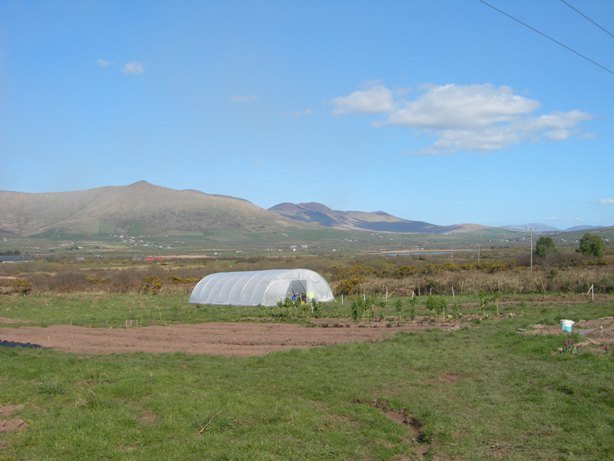
Imagine a raspberry bush in winter and then imagine its life returning in spring. What is this mystery of burgeoning life and how does it get caught in the raspberry bush? Life is the essence that raises the bush from the earth as it grows, giving it colour and fragrance in spring and the rounded taste of its fruit. The bush could not do this but for the influence of the cosmos: warmth and pure light of the sun and fresh water.
Have you noticed the luminous colour lying over the natural fields of Ireland? Do you perceive the difference in a sprayed or depleted field? The light is gone out of the latter because it is barely alive. These subtle differences also exist in food. Compare the taste and smell of an organic raspberry with one forced in chemical-laced soil. One is alive and satisfying the other largely inert and bland. Go beyond the theory of vitamins and minerals; let your body become the scientist and discern whether there is nourishment and life in the taste, smell and enjoyment of any given food.
 Tara.
Tara. A friend was recently in Virginia. I remember Virginia from childhood holidays--a breathtaking state--the ocean to the east and mountains to the west, and every shade of beauty in between. It was one of the earliest states of the Union with a long history of land cultivation. Of course there was poverty too, but there was a sense of commitment to the land and community decision.
About ten years ago I drove south from New York and saw a changed Virginia; malls and housing estates, fast food joints and superstores. It was painful to see --or rather not to see--the land. And my friend tells me it is even more so now.
I would have thought it different in Ireland whose real wealth lies in the beauty and grace of its nature. But there are permit signs on every green field and hillsides heaved up for endless unpermeated little boxes.
Even Tara--that repository of ancient protection over Ireland--it is only a convenient road, we are told, but what follows all such roads? Malls, housing estates, fast food joints and superstores, and the venerable and beneficient ghosts inhabiting the hill will flee. Where will they go? Virginia?
Friday, March 31, 2006
Christus my babe draw near
Though brightest light now overshadows
The innocents preparing your home,
The cradle and the straw,
The closeness of the animals,
The warmth of fire and the moon’s bright glow,
The angels there for all to see:
This image keeps and holds the mystery
Of your first incarnation.
And so we see that you are there for all
And in the simplest smallest way
Our savior and the savior of this earth
That we belong to.
Draw near now, permeate each grass, each drop of dew
With your sweet presence, let all be comforted.
They say the church of the Nativity stands empty:
Yes perhaps that is so for now
But if you fill the souls with love
Then rushing into emptiness will come new meaning.
I want to go where you were born and walk the path
Your earthly feet once traveled.
I want to pour my own love out
So that it spreads and spreads
Even unto coldness of stone,
Barrenness of field laid low by greed,
And suffering of beasts.
I want my love to sing out and be merry
So that stones begin to throb with joy,
The grasses grow and blossom into seed,
And beasts combine in concert
Kicking up their heels to such extent
That old earth mother and all her fairy
Helpers above and below
Ring out with laughter and well-being.
Though brightest light now overshadows
The innocents preparing your home,
The cradle and the straw,
The closeness of the animals,
The warmth of fire and the moon’s bright glow,
The angels there for all to see:
This image keeps and holds the mystery
Of your first incarnation.
And so we see that you are there for all
And in the simplest smallest way
Our savior and the savior of this earth
That we belong to.
Draw near now, permeate each grass, each drop of dew
With your sweet presence, let all be comforted.
They say the church of the Nativity stands empty:
Yes perhaps that is so for now
But if you fill the souls with love
Then rushing into emptiness will come new meaning.
I want to go where you were born and walk the path
Your earthly feet once traveled.
I want to pour my own love out
So that it spreads and spreads
Even unto coldness of stone,
Barrenness of field laid low by greed,
And suffering of beasts.
I want my love to sing out and be merry
So that stones begin to throb with joy,
The grasses grow and blossom into seed,
And beasts combine in concert
Kicking up their heels to such extent
That old earth mother and all her fairy
Helpers above and below
Ring out with laughter and well-being.

Poor is the land that carries dead soil
From far comes the wind that moves it
Burdened the folk that tarry awhile
And not tending it merely abuse it
We once had an Eden where grasses grew tall
And crickets hummed their sweet music
The fragrant abundance matured in the fall
Hands harvested, cherished and used it.
Come brothers and sisters, return to your task
Embrace what is yours—give it ferment
You know that without it your soul cannot last
Find your heart—be the earth’s willing servant.
Build a vessel for life from wealth wide and vast
A bequest to the children you parent
It will unchain your limbs, your true purpose unmask
And reward you with praise ever fervent.
Tuesday, March 28, 2006
Genetically Modified Pigs
Blogs flying around, some for and some against the issue of the socially and genetically improved pig (see Newsweek article on new phosphorus-low enviropigs, and other articles which you can find on other blogs) offering the perfect omega-3 rich grunter.
First of all, would you consider it strange that just when the issue is heating up of BASF going to plant GM modified potato seed in Ireland, and growing negative findings concerning GM, there is a diversion...the lure of an environmental and culinary MIRACLE cooked up by the genemod kitchen?
Would you find it strange that a Newsweek article writes about phosphorus pollution in rivers, but doesn't specify how that pollution came about, however connecting it to the excretions of pigs? Never mind that this was not an issue down through the ages when pigs and mankind and cows and birds lived easily together and waters were clean?
And would it not be excessively strange that in all of this the pig seems not to exist as a living, breathing, sentient being, a fairly intelligent being actually, and an affectionate one and not a thing, a product, an omega-3? Was not the farm animal cared for with respect previously and didn't this add to the nutrition of the meat it offered?
Are we going to watch our earth being destroyed because we only see its purely physical components without any consideration for the larger, subtler, connections that give us joy? An earth in which food is manipulated to create, as it were, supplements and medications for the diminishing vitality our materialists would like us not to notice?
And will we continue to fall for the repeated convenient fables and dogmas that pass for 'science' while our children are denied wholesome food so that they become too lethargic to protest? I have lived long enough to witness the decline and the hype that never lets up until we all believe it, and I can tell you, it is not funny.
Fruits have come
When all is said and done—
The myrtle creeping on the wall
Has even filled with rounded seed
And when we think that we have gone
Through thick and thin
And here and there
And now tis flown—
What will the next epoch prepare?
We have our task; we know not
has it met the needs of others—
Have we right principles and are we able?
Are all the places that we’ve had to furnish set?
The fruit laid out, is it all ready yet—
For now the guests are bidden to the table
Have we fulfilled and have we made
The purpose that we came for?
Are we now free, or is there more
And how will we be weighed?
Blogs flying around, some for and some against the issue of the socially and genetically improved pig (see Newsweek article on new phosphorus-low enviropigs, and other articles which you can find on other blogs) offering the perfect omega-3 rich grunter.
First of all, would you consider it strange that just when the issue is heating up of BASF going to plant GM modified potato seed in Ireland, and growing negative findings concerning GM, there is a diversion...the lure of an environmental and culinary MIRACLE cooked up by the genemod kitchen?
Would you find it strange that a Newsweek article writes about phosphorus pollution in rivers, but doesn't specify how that pollution came about, however connecting it to the excretions of pigs? Never mind that this was not an issue down through the ages when pigs and mankind and cows and birds lived easily together and waters were clean?
And would it not be excessively strange that in all of this the pig seems not to exist as a living, breathing, sentient being, a fairly intelligent being actually, and an affectionate one and not a thing, a product, an omega-3? Was not the farm animal cared for with respect previously and didn't this add to the nutrition of the meat it offered?
Are we going to watch our earth being destroyed because we only see its purely physical components without any consideration for the larger, subtler, connections that give us joy? An earth in which food is manipulated to create, as it were, supplements and medications for the diminishing vitality our materialists would like us not to notice?
And will we continue to fall for the repeated convenient fables and dogmas that pass for 'science' while our children are denied wholesome food so that they become too lethargic to protest? I have lived long enough to witness the decline and the hype that never lets up until we all believe it, and I can tell you, it is not funny.
Fruits have come
When all is said and done—
The myrtle creeping on the wall
Has even filled with rounded seed
And when we think that we have gone
Through thick and thin
And here and there
And now tis flown—
What will the next epoch prepare?
We have our task; we know not
has it met the needs of others—
Have we right principles and are we able?
Are all the places that we’ve had to furnish set?
The fruit laid out, is it all ready yet—
For now the guests are bidden to the table
Have we fulfilled and have we made
The purpose that we came for?
Are we now free, or is there more
And how will we be weighed?
Tuesday, March 21, 2006
Community Supported Agriculture
In 1997 a remarkable book was published by the Biodynamic Farming and Gardening Association in the US, called Farms of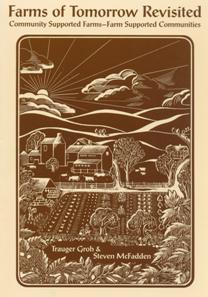 Tomorrow Revisited, co-authored by Trauger Groh and Steven McFadden. Trauger Groh is an agricultural pioneer who spearheaded the extraordinarily successful CSA (Community Supported Agriculture) movement of the mid-1980's.
Here are a few quotes:
'The financial and agricultural practices of recent decades have made it increasingly difficult for existing models of agriculture to prosper. In America, the family farm has fallen victim to a relentless marketplace; meanwhile, corporate farms have tended to place short-term economic advantage over our relationship with each other and the earth.'
'What do we want to achieve with nutrition besides keeping up our bodily functions? How can our diet support not only our physical health but also the development of our spiritual faculties so that they function in the best way? The point that men and women live longer today than in the past is a poor argument for the quality of our food if we do not pose questions about the conditions of our lives.'
'Nearly all manipulations with food--additives, radiation, and conservation methods--serve not the purpose of quality, but rather the purpose of distribution over long distances, shelf-life, and a pleasing appearance. Contrary to what might be right for many industrial products, the production, processing, distribution, and consumption of food favors quality when it is done locally.'
'We cannot move back to a rural society. We have to create a new relationship between the citizens and 'their' farmland that will make the benefits of farm experience available for anyone who seeks education, recreation, or therapy.'
The book goes on to describe steps for beginning with the CSA model.
We are fortunate to have Trauger Groh visiting us here in Dingle this June.
Technorati tags: biodynamics, agriculture, farming
In 1997 a remarkable book was published by the Biodynamic Farming and Gardening Association in the US, called Farms of
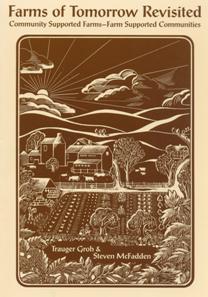 Tomorrow Revisited, co-authored by Trauger Groh and Steven McFadden. Trauger Groh is an agricultural pioneer who spearheaded the extraordinarily successful CSA (Community Supported Agriculture) movement of the mid-1980's.
 Here are a few quotes:
'The financial and agricultural practices of recent decades have made it increasingly difficult for existing models of agriculture to prosper. In America, the family farm has fallen victim to a relentless marketplace; meanwhile, corporate farms have tended to place short-term economic advantage over our relationship with each other and the earth.'
'What do we want to achieve with nutrition besides keeping up our bodily functions? How can our diet support not only our physical health but also the development of our spiritual faculties so that they function in the best way? The point that men and women live longer today than in the past is a poor argument for the quality of our food if we do not pose questions about the conditions of our lives.'
'Nearly all manipulations with food--additives, radiation, and conservation methods--serve not the purpose of quality, but rather the purpose of distribution over long distances, shelf-life, and a pleasing appearance. Contrary to what might be right for many industrial products, the production, processing, distribution, and consumption of food favors quality when it is done locally.'
'We cannot move back to a rural society. We have to create a new relationship between the citizens and 'their' farmland that will make the benefits of farm experience available for anyone who seeks education, recreation, or therapy.'
The book goes on to describe steps for beginning with the CSA model.
We are fortunate to have Trauger Groh visiting us here in Dingle this June.
Technorati tags: biodynamics, agriculture, farming
Subscribe to:
Posts (Atom)